
Overview - Surah 7: al-A`raf (The Elevated Places)
The basic theme of this Surah is Risalah, i.e. Allah's message as it was sent through many messengers. Several Prophets and parts of their stories are mentioned to emphasize Prophets’ mission and their struggle with their people. The Surah tells us that Allah's Prophets suffered for the cause of truth. Their enemies tried to harm them, but then Allah helped his prophets and defeated their enemies. The Surah emphasizes that the true message must be presented under all circumstances. After the Prophets it is the duty of the Believers to convey the message of Allah to all people.
Sections:
- The Qur’an is revealed to remind the believers and to warn humankind about the consequences of their actions. The judgment will indeed take place.
- The story of Man's creation and Satan's opposition to Man.
- Warning to the Children of Adam to be aware of Satan's plots.
- Allah's messengers came to guide people.
- The end of those who denied the message and those who accepted the message.
- Cries of the wicked in the hellfire.
- The righteous will prosper.
- Some lessons from the story of Prophet Noah - peace be upon him.
- Some lessons from the story of Prophet Hud- peace be upon him.
- Some lessons from the story of Prophets Salih and Lot - peace be upon them.
- Some lessons from the story of Prophet Shu'aib - peace be upon him.
- Warnings against those who deny the Prophets and Messengers of Allah.
- Prophet Moses -peace be upon him- and his encounter with Pharaoh of Egypt.
- Pharaoh and his magicians were defeated.
- Pharaoh continued in his persecution of the Israelites.
- Some more signs were shown to Pharaoh and his people.
- The Torah was given to Prophet Moses- peace be upon him.
- Some Israelites started Calf worship.
- The Torah and Injil speak about the coming of Prophet Muhammad (saw). Allah's promise for those who will follow the last Prophet.
- Prophet Muhammad is the Universal Prophet. Some among the people of Prophet Moses were guided by the truth and lived with justice.
- Some Israelites transgressed Allah's laws and they suffered the consequences.
- The eternal covenant of Allah was taken from all human beings.
- The coming of the Last Hour
- Shirk has no logic. Ignore the wrongdoers, but invite to Allah with kindness. Listen to the Qur'an and always remember Allah.
The Surah is named after the story of the men awaiting on the “Elevations” between Paradise and Hell.
It comprises of 206 Ayat.
Overview
| Total Ayat | 206 |
| Total Words * | 3320 |
| Root Words * | 489 |
| Unique Root Words * | 14 |
| Makki / Madani | Makki |
| Chronological Order* | 39th (according to Ibn Abbas) |
| Year of Revelation* | 13th year of Prophethood |
| Events during/before this Surah*
, 2nd Pledge of Aqabah, 1st Pledge of Aqabah, Death of Abu Talib - Death of Khadijah - Stoning at Ta'if - al-Isra wal Mi'raj - Night Journey, Boycott of Banu Hashim Yr 3, Boycott of Banu Hashim Yr 2, Boycott of Banu Hashim Yr 1, 2nd Migration to Abyssinia, Physical beating and torture of some Muslims - 1st Migration of Muslims to Abyssinia, Public Invitation to Islam - Persecution of Muslims; antagonism - ridicule - derision - accusation - abuse and false propaganda., Revelation begins - Private Invitation to Islam , Revelation begins - Private Invitation to Islam , Revelation begins - Private Invitation to Islam
| |
| Events during/after still to occur*
Migration from Makkah to Madinah - Building of Masjid Nabi in Madinah - Treaty with Jews of Madinah - Marriage of Prophet to Aishah,Change of Qiblah from Jerusalem to Makkah - Battle of Badr,Battle of Uhud,,Battle of Ahzab - Expedition of Banu Quraydhah,Treaty of Hudaiybiyah - Letters to Kings and Rulers,,Conquest of Makkah - Battle of Hunain,Hajj led by Abu Bakr - Expedition of Tabuk,Farewell Hajj by Prophet - Death of Prophet - End of Divine Revelation
| |
| Names of Prophets Mentioned
Adam, Nuh, Hud, Salih, Lut, Shuaib, Musa, Harun
| |
| Surah Index
‘Aad, Aaron, Adam, Adam (angels to prostrate before) , Adam (tree of knowledge) , Adam (banishment from Garden (no blame to Eve)) , Adversity (not burdened beyond capability to withstand) , Adversity (patience during) , God (made no laws regarding that of which He didn’t speak) , Apes (despicable) , Astronomy (celestial mechanics) , Children (of Israel) , Clothing, Commandments (general religious) , Disbelievers, Dogs, Earth, Earth (creation of) (in six days), Earth (rotation of) , Earthquake, Golden Calf, Gospel, Hell, Hud, Humankind (creation of) , Humankind (creation of) (from clay), Iblis, Jinn, Judgement (Day) , Knowledge (obligation upon man to obtain and impart) , Life (good things made lawful) , Lot, Madyan, Manna, Moses, Moses (bringing forth water from the rock) , Moses (duel by sorcery with Pharaoh’s magicians) , Moses (forty nights upon Mt. Sinai) , Moses (plagues) , Muhammad (not a madman) , Muhammad (only a prophet) , Muhammad (unlettered prophet) , Noah, Noah (ark) , Noah (flood) , Pharaoh, Prayer (beautify (adorn) yourselves for) , Prayer (prostration) , Pregnancy, Prophet (people who are false prophets are wicked) , Quail, Qur’an, Religion, Religion (is not play and transient delight) , Resurrection (Day) , Resurrection (of soul) , Revelation, Sabbath (breakers) , Salih, Sea, Shu’ayb, Sin, Ten Commandments, Thamud, Thamud (rock dwellings) , Thamud (she camel) , Thamud (she camel) (killing of), Thamud (she camel) (punishment for), Torah, Twelve tribes, Twelve tribes (scattering of) , Weather (clouds) , Weather (rain) , Weather (wind)
| |
The central theme of both Surah al-An’am and al-A’raf deal with the core issues of Faith but from different perspectives. Surah al-An’am presents the topic of Aqeedah and its realities by primarily focusing on the Jahilliyah [ignorance] of the Arabs whilst Surah al-A’raf deals with the Jahilliyah [ignorance] from a wider historical perspective, hence we find mention of Adam, Nuh People of Thamud, Lut, Madyan and Pharoah and his people.
Al-A'raf - The Elevations. Allah mentions Paradise and Hellfire and then speaks of the 'elevations' between them reserved for some amongst humanity. These people not knowing what will happen to them. The people of Hell-fire will be refused water as it will be prohibited for the disbelievers in the after-life.
Manuscripts / Inscriptions
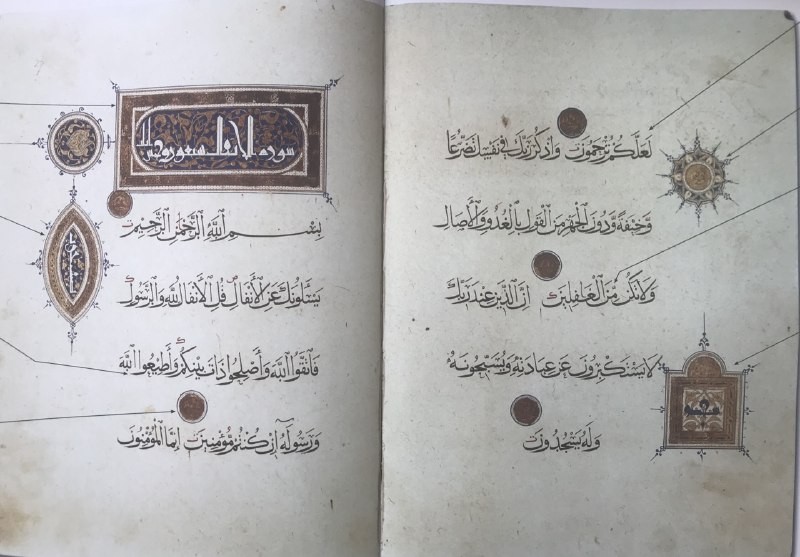
14th Century
14th Century

8th century
8th century

7th century
7th century
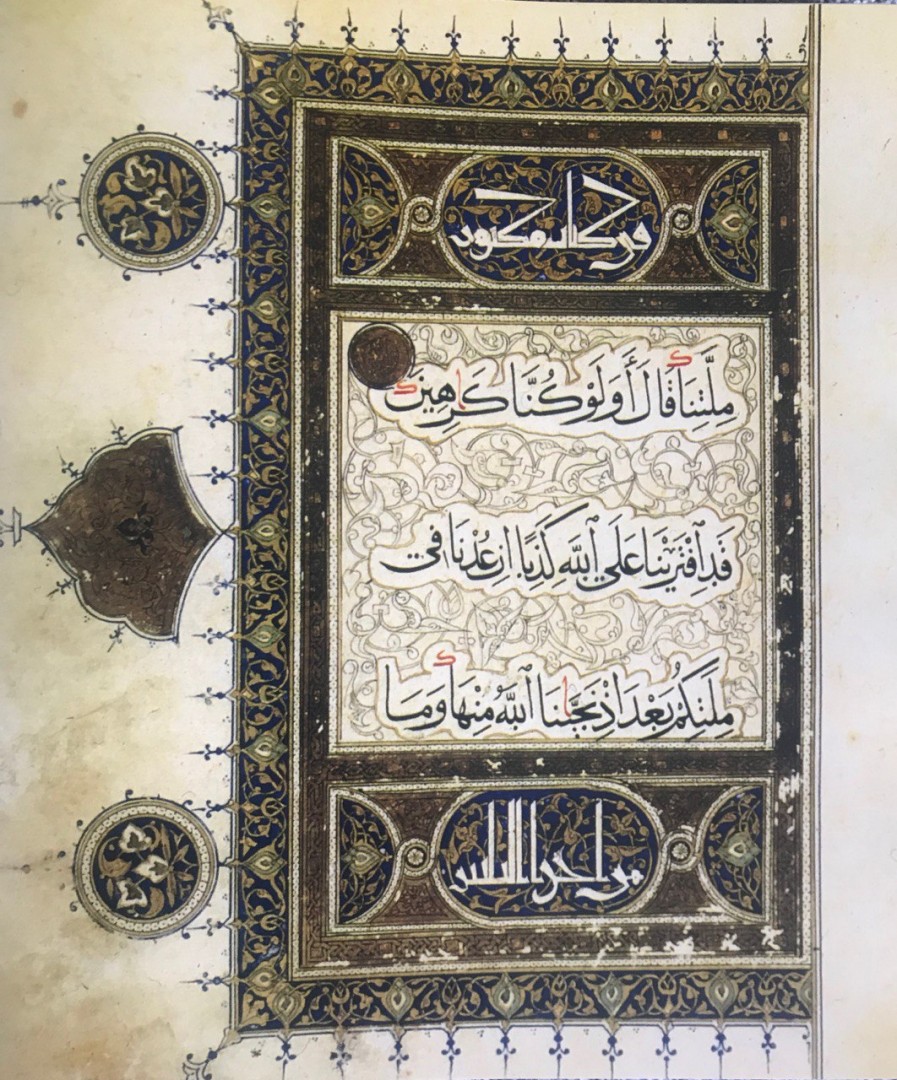
14th Century
14th Century

18th Century
18th Century

1130 AH (1717 CE)
1130 AH (1717 CE)

1130 AH (1717 CE)
1130 AH (1717 CE)

1271 AH (1855 CE)
1271 AH (1855 CE)

1271 AH (1855 CE)
1271 AH (1855 CE)

1st Century Hijrah (7th Century CE)
1st Century Hijrah (7th Century CE)

Late 1st century / 2nd century of Hijrah
Late 1st century / 2nd century of Hijrah

1st century / 2nd century of Hijrah
1st century / 2nd century of Hijrah

1st century / 2nd century of Hijra.
1st century / 2nd century of Hijra.
The central theme of both Surah al-An’am and al-A’raf deal with the core issues of Faith but from different perspectives. Surah al-An’am presents the topic of Aqeedah and its realities by primarily focusing on the Jahilliyah [ignorance] of the Arabs whilst Surah al-A’raf deals with the Jahilliyah [ignorance] from a wider historical perspective, hence we find mention of Adam, Nuh People of Thamud, Lut, Madyan and Pharoah and his people.
Surah al-A’raf adopts a totally different approach as it discusses the same question of Faith. It provides for it with the panoramic setting of human history. It starts with mankind’s journey as it begins in heaven and where it aims to return. Along this great expanse, we see the procession of faith starting with the Prophet Adam to the last of all prophets and messengers, Muhammad (peace be upon him). The procession holds the banner of faith and advocates, throughout human history, that the only way to human happiness is for people to adopt the faith based on God’s oneness. The surah outlines what reception this call received in different periods of history; how the leaders of this procession put the message across to mankind, and the responses they received; how the people in power went about conducting their campaigns of opposition and how the procession of believers brushed them aside and went along its way. This surah also portrays the fate that befell opponents of faith in this life and the different destinies in the hereafter of both believers and unbelievers.
It is a very long journey, but the surah takes us along, stage by stage, making a stop at every landmark to indicate that the road is clearly demarcated with well known starting and finishing lines. All mankind travels along, aiming to return to the point where it started, in heaven, with the Supreme society. [REF: Qutb, Fi Dhilal al-Qur’an]
- The previous surahs contain the new Mithaq [covenant] between Allah and the Muslim Ummah. This surah chronicles just how the previous nation, Bani Israel behaved with this Mithaq and how a person from amongst them [7:175] detached himself from the Revelation and the consequences of such actions.
It has been reported that the Prophet reciting this surah during Salatul Maghrib. [Sunan an-Nisai al-Kubra no.1061, Tafsir al-Maudhui, Dr. Mustafah Muslim.]
- Interesting note in connection to the central theme: we find this surah has used the word قرية (Qaryah) [and its various grammitical forms – meaning city, town] 10 times – the most frequent compared to any other surah.
- We also find the word أمة (nation) used 8 times in its various forms – also more than any other surah. This is revealed in the last year of the Makkan period and on the eve of the creation of the Islamic state and birth of the Muslim Ummah – hence the most important lessons.
- This Surah has mentioned 'Adam' seven times - more than any other Surah.
- There are more mentions of Musa in this Surah than any other Surah of the Qur'an.
- Words derived from R-B-B- (Lord, owner, master) appear 65 times in this Surah. The highest frequency compared to any other Surah.
- The word M-L-A' - Cheifs/leaders appears 9 times in this Surah. The highest frequency compared to any other Surah.
-
وَإِلَىٰ عَادٍ أَخَاهُمْ هُودًا ۗ قَالَ يَا قَوْمِ اعْبُدُوا اللَّـهَ مَا لَكُم مِّنْ إِلَـٰهٍ غَيْرُهُ ۚ أَفَلَا تَتَّقُونَ "And to the 'Aad [We sent] their brother Hud. He said, "O my people, worship Allah; you have no deity other than Him. Then will you not fear Him?" (7:65)
This is the first mention of the Prophet Hud in the Qur'an (the Prophet Hud is mentioned most in Surah Hud, a total of five times).
- Interesting note in connection to the central theme: we find this surah has used the word قرية (Qaryah) [and its various grammitical forms – meaning city, town] 10 times – the most frequent compared to any other surah.
- We also find the word أمة (nation) used 8 times in its various forms – also more than any other surah. This is revealed in the last year of the Makkan period and on the eve of the creation of the Islamic state and birth of the Muslim Ummah – hence the most important lessons.
- This Surah has mentioned 'Adam' seven times - more than any other Surah.
- There are more mentions of Musa in this Surah than any other Surah of the Qur'an.
- Words derived from R-B-B- (Lord, owner, master) appear 65 times in this Surah. The highest frequency compared to any other Surah.
- The word M-L-A'- (Cheifs/leaders) appears 9 times in this Surah. The highest frequency compared to any other Surah.
Total Word Count per Ayat (shows how many words per Ayat) = 14* | ||
| # | Root Word | Frequency in Surah | Frequency in Qur'an |
|---|---|---|---|
| 1. | ق و ل | 110 | 1722 |
| 2. | ك و ن | 74 | 1390 |
| 3. | أ ل ه | 70 | 2851 |
| 4. | ٱلَّذِى | 67 | 1464 |
| 5. | ر ب ب | 65 | 980 |
| 6. | ق و م | 55 | 660 |
| 7. | أ م ن | 36 | 879 |
| 8. | ر س ل | 30 | 513 |
| 9. | إِلَىٰ | 29 | 742 |
| 10. | أ ي ي | 29 | 382 |
| Root Word | Frequency in Surah |
Frequency in Qur'an |
|---|---|---|
| ق و ل | 110 | 1722 |
| ك و ن | 74 | 1390 |
| أ ل ه | 70 | 2851 |
| ٱلَّذِى | 67 | 1464 |
| ر ب ب | 65 | 980 |
| ق و م | 55 | 660 |
| أ م ن | 36 | 879 |
| ر س ل | 30 | 513 |
| إِلَىٰ | 29 | 742 |
| أ ي ي | 29 | 382 |
A study of its contents clearly shows that the period of its revelation is about the same as that of Surah 6: al-An’am (The Grazing Livestock), i.e. the last year of the Prophet's life at Makkah, but it cannot be asserted with certainty which of these two were sent down earlier. The manner of its admonition clearly indicates that it belongs to the same period. [Ref: Mawdudi]
It is considered the longest surah revealed during the Makkan period. Some consider this surah to have been revealed after Surah 38: Sad. [Ref: Tafsir al-Maudheei, Dr. Mustafah Muslim, vol. 3, p. 2]
- An invitation is given to the People of the Book (Jews and Christians) to become Muslims.
- A warning is given to the unbelievers about the consequences of their denial through citing the example of punishments which were inflicted upon former people for their wrong attitude towards their Rasools.
- The Jews are warned about the consequences of their hypocritical conduct towards the Prophets.
- Commandment to propagate the message of Islam with wisdom.
- The fact that the Rasools as well as the people to whom they are sent will be questioned on the Day of Judgement.
- Commandment to the Believers that they should wear decent and proper dress and eat pure and good food.
- Dialogue between the residents of paradise, the inmates of hell and the people of A'raf (a place between the Paradise and hell).
- The fact that affluence and adversity are the reminders from Allah.
- The fact that Muhammad (pbuh) is the Rasool for the all of mankind.
- The fact that the advent of Muhammad (pbuh) was described in Torah and the Gospel (Bible).
- The fact that the Jews have fabricated a wrong belief about Allah's forgiveness.
- Mankind's testimony about Allah at the time of Adam's creation.
- The fact that Allah created all of mankind from a single soul.
- Allah's commandment to show forgiveness, speak for justice and avoid the ignorant.
- Allah's commandment about listening to the recitation of The Qur'an with complete silence.
Tafsir Zone
|
Sayyid Qutb Overview (Verses 88 - 89) No Retreat Contemplated Threats and warnings cannot shake or intimidate a strong faith. Shu`ayb made his stand taking a position from which he could not budge an inch. That was the position of peaceful coexistence which would allow every individual to adopt the faith of his or her choice and submit to the authority which he or she acknowledged, awaiting God’s judgement between the two groups. No advocate of a divine faith can make even the smallest compromise beyond this point, great as the pressures to which he is exposed may be. Otherwise, he would betray the truth he advocates. When the arrogant chiefs of his people responded to his offer by threats of expulsion from their land unless he toed their line, Shu`ayb stood up for the truth, declaring that he would not go back to the false faith after God had rescued him from it. He turned to his Lord and protector, appealing to Him for support against the advocates of evil: “He said: ‘Even though we are unwilling? We should be guilty of fabricating lies against God, if we were to return to your ways after God has saved us from them. It is not conceivable that we should return to them, unless God, our Lord, so wills. Our Lord has full knowledge of everything. In God we place our trust. Our Lord, lay open the truth between us and our people; for You are the best to lay open the truth. “(Verses 88-89) These few words epitomize the nature of faith and its effect on the believers as well as the nature of jāhiliyyah and its hateful effects. We also see clearly how the divine truth makes the Prophet’s heart come alive: “He said. ‘Even though we are unwilling?’” (Verse 88) His attitude is one of total denunciation of their despotic threats: “We shall indeed expel you, Shu`ayb, and your fellow believers from our land unless you return to our fold.” (Verse 88) He asks them whether they are prepared to go all the way and force him and his fellow believers to return to their faith after God has saved them from it: “We should be guilty of fabricating lies against God, if we were to return to your ways after God has saved us from them.” (Verse 89) A person given guidance by God but who reverts to false beliefs which do not require people to submit themselves totally to God and to obey Him alone makes false testimony against God and His faith. The sum of that testimony is that he could not find anything good in divine faith, so he abandoned it to readopt the creed of the tyrants. Or at least his testimony means that the tyrants’ creed also has the right to exist and exercise power, and can exist side by side with divine faith. Thus, he returns to it and recognizes it after he has believed in God. Such a testimony is far more serious than that of a person who has not experienced God’s guidance and declared his submission to God. It acknowledges as legitimate the tyrants who usurp God’s authority over human life. Shu`ayb also denounces the tyrants’ threats to force him and his followers back into erroneous faith: “It is not conceivable that we should return to them.” (Verse 89) It is simply impossible. Shu`ayb makes this statement in the face of threats backed by the might of the tyrants. Indeed, tyranny adopts the same attitude towards every Muslim community, wherever it exists, once it declares its rejection of tyranny and submits at the same time to God alone, associating no partners with Him. Hard as the cost of rejecting tyranny and submitting to God alone may be, it is far easier to bear than the burden of submitting to tyrants. The latter submission may appear to ensure safety, security and a life of peace where a person can work and earn his living, but its cost is too hard and long lasting. The cost is paid out of man’s very humanity, because man does not fulfil himself if he submits to another human being. What submission is worse than yielding to the laws enacted by another human being? What submission is worse than attaching one’s destiny to the will of a fellow human being and to his pleasure and capricious desire? What could be worse than a human being with a bridle by which another person leads him wherever he wishes? But the matter does not rest at this high level of beliefs and authority. It becomes more and more mundane so as to claim, under tyranny, people’s property which will not be safeguarded by any law. It claims also their very children who are brought up to accept whatever concept, ideas, morals, traditions and customs, tyranny wishes them to adopt. In addition, tyranny imposes its control over their souls and lives, making of them an offering for its own caprice and erecting of their skulls and remains a monument for its glory. It then claims their honour. Under tyranny, no father can protect his daughter from disgrace, either by being flagrantly raped, as happens throughout history, or through implanting in her mind certain concepts that facilitate for her promiscuity under any guise and make her an easy target for unscrupulous seducers. Whoever imagines that he protects his property, honour, life and the lives of his sons and daughters under tyranny which usurps God’s authority is living in self delusion. Under tyranny people lose their sense of reality. To submit to tyranny is to burden oneself with an extremely heavy cost in terms of personal esteem, honour and property. Whatever burden a person finds himself required to bear for submitting himself to God is far easier and more profitable even by the standards of this present world. This is not to speak of what submission to God is worth by God’s own measure. No Sorrow for Unbelievers’ Fate As Islam calls upon people to retrieve all authority usurped by human beings in order to return it all to God, it simply calls on them to rescue their humanity and save themselves from submission to fellow creatures. When they make a positive response, they actually save their souls and their property from the designs of tyrants, that serve their desires. In so doing, Islam requires its followers to bear the full burden of fighting tyranny, under its own banner, giving all the sacrifices such a fight may require. But at the same time, it spares them having to give sacrifices that are much more costly and humiliating. It protects their dignity and ensures their own safety at the same time. Hence, the Prophet Shu`ayb [peace be upon him] makes his statement loud and clear: “We should be guilty of fabricating lies against God, if we were to return to your ways after God has saved us from them. It is not conceivable that we should return to them.” (Verse 89) Thus Shu`ayb stands up to the arrogant chiefs of his people, making his attitude absolutely clear and with his head raised high. Yet at the same time, he hangs his head down before his Lord, declaring his submission to Him alone, recognizing that His knowledge encompasses everything in the universe. As he refers to his Lord, he makes no final statement concerning what may happen. He simply declares that he has surrendered himself completely to God: “It is not conceivable that we should return to them, unless God, our Lord, so wills. Our Lord has full knowledge of everything.” (Verse 89) This is an indication of complete submission to God by Shu`ayb and the believers who followed him. He makes clear that he can, at his own behest, refuse what tyrants require him to do of returning to their faith. He declares that he and his followers have no desire for such a return which sounds in principle totally unacceptable. But he, nevertheless, makes no categorical statement concerning what God may do with him or his followers. God’s will is free and absolute. Neither he, nor those who have believed with him, have any knowledge of what God may decide to do with them, while their Lord has full knowledge of everything. Hence, they submit to God’s will and knowledge. This is the mark of good manners which believers are keen to demonstrate in their dealings with God. At this point, Shu`ayb leaves his people and their threats aside, declaring that he relies totally, and with absolute confidence, on God who is certain to judge between him and his people in accordance with the truth: “In God we place our trust. Our Lord, lay open the truth between us and our people; for You are the best to lay open the truth.” (Verse 89) These few words portray a fascinating scene when the truth of Godhead is clearly seen and properly felt by His friend and Prophet. The Prophet knows the source of all power and the secure refuge that can be found there, and he realizes that it is his Lord who can judge in truth between faith and tyranny. He places his trust completely in his Lord before he goes into the battle that is imposed on him and his followers. He realizes that he cannot win that battle unless his Lord grants him victory. |
Ibn Kathir (English)
Sayyid Qutb
Sha'rawi
Al Jalalain
الطبري - جامع البيان
ابن كثير - تفسير القرآن العظيم
القرطبي - الجامع لأحكام
البغوي - معالم التنزيل
ابن أبي حاتم الرازي - تفسير القرآن
ابن عاشور - التحرير والتنوير
ابن القيم - تفسير ابن قيّم
السيوطي - الدر المنثور
الشنقيطي - أضواء البيان
ابن الجوزي - زاد المسير
الآلوسي - روح المعاني
ابن عطية - المحرر الوجيز
الرازي - مفاتيح الغيب
أبو السعود - إرشاد العقل السليم
الزمخشري - الكشاف
البقاعي - نظم الدرر
الهداية إلى بلوغ النهاية — مكي ابن أبي طالب
القاسمي - محاسن التأويل
الماوردي - النكت والعيون
السعدي - تيسير الكريم الرحمن
عبد الرحمن الثعالبي - الجواهر الحسان
السمرقندي - بحر العلوم
أبو إسحاق الثعلبي - الكشف والبيان
الشوكاني - فتح القدير
النيسابوري - التفسير البسيط
أبو حيان - البحر المحيط
البيضاوي - أنوار التنزيل
النسفي - مدارك التنزيل
ابن جُزَيّ - التسهيل لعلوم التنزيل
علي الواحدي النيسابوري - الوجيز
السيوطي - تفسير الجلالين
المختصر في التفسير — مركز تفسير
|
|
|
- Surah Al-Araf (The Heights) Saad al Ghamidi https://www.youtube.com/watch?v=tvJmEeRYGag&index=7&list=PLFBCB5C33480F350C
- Surah Al-Araf Mahmoud Khalil Al Hussary https://www.youtube.com/watch?v=IAIqY4YG5v4&index=7&list=PLxpAkjlGauHfMFWX22VZWOKpzjr-vH_BM
- Surah Al-Araf Muhammad Al Luhaydan https://www.youtube.com/watch?v=8PH63X7q_Wk&list=PLxpAkjlGauHfKAYuQLRNAZomoezhfhRZe&index=7
- Surah Araf Idris Akba https://www.youtube.com/watch?v=MP1DvywAaoI
- Surah Al-Araf muhammad Minshawi https://www.youtube.com/watch?v=GdAOUom0mP4&list=PLxpAkjlGauHdUcO_uc-8F8J2NUQRDZjPG&index=7
- Dr Israr Ahmed Tafsir Surah Al-An'am (130) to Surah Al-A'raf (1-37)2 https://www.youtube.com/watch?v=yMuuDJXS-0A&index=38&list=PLB4B8D1654A8BD263
- Dr Israr Ahmed Tafsir Surah Al-A'raf (38-131)1 https://www.youtube.com/watch?v=XT223pGb-4k&index=39&list=PLB4B8D1654A8BD263
- Dr Israr Ahmed Tafsir Surah Al-A'raf (38-131)2 https://www.youtube.com/watch?v=qMsXRQtXN8w&index=40&list=PLB4B8D1654A8BD263
- Dr Israr Ahmed Tafsir Surah Al-A'raf (132-end)1 https://www.youtube.com/watch?v=3s2AOg0EbWM&list=PLB4B8D1654A8BD263&index=41
- Dr Israr Ahmed Tafsir Surah Al-A'raf (132-end)2 https://www.youtube.com/watch?v=5lcwRd9aqOw&index=42&list=PLB4B8D1654A8BD263


